Category Archives: Bands/Artists I rate very highly

Bands/Artists I rate very highly

Brief thoughts – Roberto Olzer Trio: Steppin’ Out

I first heard the Roberto Olzer Trio play the Sting cover Every Little Thing She Does is Magic and bought the album on the whim that any trio containing bass player Yuri Goloubev was worth listening to. My hunch was justified. This is a lovely album of jewelled lyricism by Italian pianist Roberto Olzer. The jaunty Sting cover is not typical of the album, it is memorable but then so are the other nine tracks. Roberto studied the organ and I think this shows in the delicate layers of sound that hang around like the echo of an organ in the fan vaulting of a cathedral, you look up and feel wonder. The album is very visual, each track seems to tell a story, from the unsteady Madman of the opening, to FF (Fast Forward) which seems to want to trip up each musician. Especially beautiful is tragic Gloomy Sunday where the bass is intent on wallowing in misery. The sound swells and falls, like good ideas dismissed out of pessimism. You almost need to listen to each track on its own, they are exquisite short stories you want to savour.

It was recorded and mixed by Stefano Armerio in June 2012 (he also recorded Maciek Pysz’s Insight). Deserves a wider audience, especially in the UK.

RobertoOlzer

Roberto Olzer, piano
Yuri Goloubev, double bass
Mauro Beggio, drums

http://www.robertoolzer.com/

Some thoughts on Rothko, megalithic architecture and jazz…

I felt at home in the 6000 year old Hal Saflieni Hypogeum, Paola, Malta. The shapes were familiar, I had seen them in Rothko. These mysterious underground chambers, majestic burial places, were excavated by hand using tools of antler and flint, the limestone smooth as silk. Their perfect proportions of aperture and lintel thickness struck me as timeless. These softly lit caverns awed us to silence. In our mind’s eyes, we heard the scrape of flint on stone, the drip of rainwater in winter, the quiet conversation of the workmen eons ago. In a museum in Valletta we saw some offerings to the dead taken from these chambers. A tiny sleeping woman, fashioned from stone, her winter skirt of sheepskin-like stone gently crinkled at its hem, her best skirt. Such humanity touches us across the millennia. Move forward to the 20th century, and Rothko. His Red on Maroon could overwhelm you. Those huge vertical columns and apertures look like windows or doors, the sombre tones shift as you gaze at them, making you feel uneasy. But there is nothing there.

Maroon by Maciek Pysz on his album Insight was inspired by this same Rothko. It’s contemplative, and unlike the other compositions on this album, this one is not sunlit, it is permeated by loss and reflective sadness. As I stood in one of the chambers of the Hypogeum I heard Asaf Sirkis’s gentle udu drum, it could have been the patter of rainwater, or a drum from 6000 years ago. Yuri Goloubev’s delicate bass playing could just as easily have been inspired by the painting or the need to ease our passage from life to the afterlife as I experienced in those cool chambers.

All too soon, we were in a sunlit street, wondering if we had imagined all that was beneath our feet, marvelling that such beauty could have been visualised by our ancestors and then made to happen.

the-hal-salfieni-hypogeum

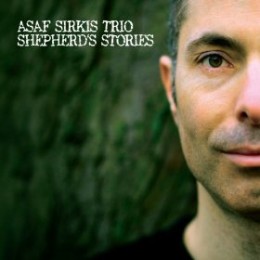
Album review: Asaf Sirkis Trio: Shepherd’s Stories – released July 2013

A sheep and a lamb gambol on a green hillside, the artists stand in a forest, they wear hoods – they could be shepherds. They aren’t of course, they are members of the outstanding trio of drummer Asaf Sirkis. This is the same trio that gave us Letting Go in 2010. And now this album, Shepherd’s Stories. It’s as if those three years are just a few minutes, as if time does not really matter to Asaf. The haunting harmonica of the earlier album has made way for voice and flute, and just as effectively. The trio has its own recognisable sound – a mix of out-of-this-world pulsating guitar trajectories and shimmering, sizzling, explosive percussion. The guests add more than colour, they add another dimension, a very human one that we can connect with.

In the sleeve notes Asaf tells us that Shepherd’s Stories are reminders of where we have come from, they are metaphors for feelings deep within us, that come unprompted when we hear certain melodies. In a well-balanced album, this idea of atavistic memory is most strikingly demonstrated in two tracks – Traveller and Together. In Traveller, the gentle, cool and beautiful voice of Sylwia Bialas takes us to distant lands where shepherds guard their flocks, where simple tunes move us, where we feel at home. This simplicity is deceptive, it hides complex bass picking, the subtlest drumming and blended voices. Then in Together the ravishing, mellifluous flute of Gareth Lockrane takes me straight into the Middle East, to an almost biblical time. As a boy, did Asaf hear melodies like this one float across hillsides in his native Israel? It is quite timeless, Asaf is right, we already know this tune, this touching emotion, even though most of us lead urban lives. The opening is like the breathing you adopt in meditation, you push other thoughts aside as you relax. You might have imagined from looking at the instrumentation (guitars and drums), and hearing the searing guitar on the first track, that this would be a rock-jazz album but it isn’t, it is overwhelmingly serene and very rewarding.

This album will definitely grow on you. Highly recommended.

Asaf Sirkis

All compositions by Asaf Sirkis

Asaf Sirkis, drums
Yaron Stavi, electric bass
Tassos Spiliotopoulos, electric and acoustic guitars
with guests Sylwia Bialas, voice; Gareth Lockrane, flute; and John Turville, fender rhodes

www.asafsirkis.co.uk

Album review: Alex Jønsson 3: The Lost Moose – released May 2013

There are some people who are very fortunate to hear music in colour. At the recent Cheltenham Science Festival I saw the emergence of a beautiful piece of abstract art painted in front of our eyes whilst we listened to a live performance of Mussorgsky’s Pictures at an Exhibition. The artist Philippa Stanton has synaesthesia, she “sees” sounds as moving images and she captures them in colours. The result was stunning: deep blues and purples for lower register notes, a serene green midway and paler shades for higher notes. Only on stepping back could we appreciate the beauty and harmony of the creation. How we respond to music is subjective but, in those with the condition, the brain consistently associates sounds with specific colours. The condition is prevalent in one to two per cent of the population and unsurprisingly, perhaps, there is a higher incidence in musicians.

I am not a synesthete but for me The Lost Moose by the Alex Jønsson 3 is delicate shades of landscape grey, aqua and moss, and it has the same effect as a very fine woollen sweater, its absense of weight deceptive. The subtle fairy-tale-feel album cover probably stimulated this response even before I heard the first notes. The Lost Moose is the debut album by Danish guitarist Alex Jønsson, who is joined by Lars Greve on clarinet and saxophone, and Christian Windfeld on drums. The opening track sets the tone, you wonder if you are hearing a lute rather than a guitar, there is a 16th century melancholy feel in the first minute and it never leaves you till the last note of Näkemiin, (Til we meet again). It’s a pilgrimage, we pass through the ancient capital and see a Gothic cathedral, spend idyllic time in tiny remote villages and islands, relish food, experience vertigo, run out of painkillers and say goodbye to those we meet on the road. A timeless road trip rendered in muted colours. Its minimalism is its strength, you can appreciate each delicate sound. Everything is pared back, slowed down. I can imagine words to these lovely tunes, a voice complementing the clarinet. It is not all quietness: in Afraid of heights I do feel I am looking over the edge, it’s quite scary, the earth seems to shake, the guitar and drums a shock after the gentleness.

This is a very beautiful album which succeeds perfectly in creating a consistent and sustained atmosphere through a very rich palate of sounds (or subtle colours). Alex is part of Foyn Trio!, a delightfully quirky jazz crossover band where he plays guitar and backing vocals, and their Joy Visible was nominated for a Danish Music Award. With this pedigree behind him already, in The Lost Moose he has created a distinctive distant world, one in which to lose yourself, one which leaves you enriched by its gentleness and space. Highly recommended.

The Lost Moose

All compositions by Alex Jønsson

It was recorded in Studio Epidemin in Gothenburg, Sweden and recorded & mixed by Johannes Lundberg. Mastered by Petter Eriksson.

Alex Jønsson, guitar
Lars Greve, clarinet and saxophone
Christian Windfeld, drums

The Lost Moose available at http://alexjonsson.dk/

Album launch: Kenny Wheeler Mirrors – 25 May 2013

An excited full house at Hall One, Kings Place on 25 May 2013.  We were there for the launch of Kenny Wheeler’s Mirrors,  his settings of poems by Stevie Smith, Lewis Carroll and WB Yeates, with vocals by Norma Winstone and the London Vocal Project.   My anticipation was sharpened by a  pre-concert talk by Pete Churchill.  In a short, perceptive and enjoyable talk we learned that Kenny writes deceptively easy music within complex chords, that he allows his musicians freedom to destroy his work, that he creates order out of chaos and madness.   Like a swan serenely gliding by, we are unaware of the energy and strength beneath that swan.  We learned that sad songs make him happy.  And indeed you are constantly teased in this work by the airy voices of the choir, sounding so Sixties and optimistic, contrasting with lyrics rife with loss, death and mourning.   How masterly.

So, briefed with his insight, we listened and were rewarded with a glorious performance of Mirrors in its entirety,  played without interval.   The vast London Vocal Project, led very subtly by Pete Churchill from the far side of the stage, sounded dazzling, the result of five years singing together.   Their light and young voices, and obvious love of the music, perfectly enunciated the profound, and at times, quite mad, lyrics.  Everyone from the album was there, except James Maddren, replaced by the always reliable Martin France on drums.   The sound was perfect, so flawless you didn’t have to think about it.

At centre stage, the slight modest figure of Kenny, flanked by Mark Lockheart on saxophones, Nikki Iles on piano and Norma Winstone.  All put in bravura, moving performances, Kenny especially so, rising from his chair on at least two occasions to acknowledge our applause, his fragile notes floating in the air.  It was a very special, poignant, evening that matched the promise and rewards of the album.  There was a real buzz at Kings Place afterwards, as if people did not want the evening to end.

Mirrors by Kenny Wheeler with Norma Winstone and the London Vocal Project is available from Edition Records