
Gig review: Empirical – 4 December 2013, Warwick Arts Centre

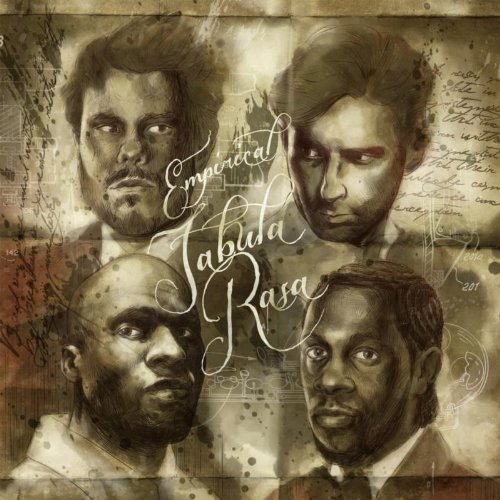
EmpiricalIt was the last night of Empirical’s tour promoting their fourth album, Tabula Rasa, and they fooled around – not with the music of course but in their interaction with each other – in Empiricism,  drums and bass made it almost impossible for the vibes to enter, he tried and then stepped back, only to return with gentle vengeance, a layer of shimmering sound like bubbles under water. In a beautifully shaped evening they reached back into their catalogue and gave us Eric Dolphy’s Gazzelloni  from Out n In,  and Yin & Yang  and In the Grill  from Elements of Truth and tasters from their latest double album. From the painful, shrieking Conflict in our Time  to the sublime vibes in The Healer,  the band showed they are masters of pacing, mood change and colour.

Of course we missed the elegant Benyounes String Quartet, who share the album and graced the album launch at the Purcell Room in October this year on tracks such as Ascent and Descent. Perhaps it was correct to omit such sublime compositions for our gig.  But it only took thirty seconds for the old Empirical magic to grab me again, that sound that sends shivers down my spine.  They are wonderful, exciting, to look at – it’s not just the suits, or Nathaniel’s elegant shoes with patent trim. No, it’s the graceful way that Tom moves his hand away from his bass in a gentle ark; the precision with which Lewis Wright places his mallets at right angles on the bars; the way Shaney Forbes’ drumsticks create lines in the air like the tracery of a Jackson Pollock, the minute attention lavished on his alto sax by Nathaniel Facey, every note the result of care and thought. And then there’s the sound, dizzying, disorientating, intoxicating, heady like an exotic bloom.  It resonates through the floor, your seat, your rib cage, into your brain.  They are quite like no other band for taking you to new places, stretching you, just go with them, their judgement is as impeccable as their tailoring!

Catch them in Cardiff at the Royal Welsh College of Music on 17 January 2014 and Birmingham CBSO on 18 January 2014.  They are rare and special, and deserve the very best venues and acoustics.

Empirical:
Nathaniel Facey, alto saxophone
Lewis Wright, vibraphone
Tom Farmer, double bass
Shaney Forbes, drums

Website Empirical

Mary James, 5 December 2013
Great expectations: London Jazz Festival 2013

Last night on Twitter I summed up my reactions to this year’s EFG London Jazz Festival in a few words:

The huge smile that is Troyk-estra / the power of Phronesis / the majesty of Brad Mehldau / the fun of Sons of Kemet

Many more images and sounds come flooding back:  the awkward stance of Brad Mehldau,  seated with his back to the entire audience, right hand on Steinway , left arm reaching up across his body to an ancient and very deep synth; or maybe he was Prospero conjuring magic from his battery of keyboards, so many fizzing, spacey layers of sound to keep track of yet he kept everything in order, each composition a perfect journey in one direction or another;  his lopsided expression as he took his bow (was he pleased?);  the smell of real smoke at the start of the Sons of Kemet set; the energy of Anton Eger on drums,  his head bucking like a prize stallion tugging at the reins;  bright lights raking the audience in Sons of Kemet, making us feel part of the act;  Kit Downes striking the keyboard so quickly he could just as easily have been receiving electric shocks from the keys;  Jasper Høiby embarrassing latecomers to the set, not once but twice, his ironic comment that the live recording was “No big deal” (when their mesmerising urgent sets indicated that they were playing for the highest stakes); the sparkling fingerwork by Alexi Tuomarila on a humble upright piano at Ray’s Jazz; catching the end of a set by a stellar quintet of Kenny Wheeler, John Taylor, Chris Lawrence, Stan Sulzmann and Jim Hart in the Clore Ballroom; hearing David Redfern tell us that jazz photographers are born not made; learning that just one picture can sum up an artist – not the obvious image but the one that is most honest because it was unposed (Oscar Peterson with his head in one hand, maybe anxiety before a performance or pain, or both?).

My thoughts shift like the particles in a kaleidoscope.  Sometimes I felt alienated by a performance that others were enjoying – Nik Bärtsch is a case where I felt manipulated by the lighting, the staginess of it, the performance felt controlled and controlling.  I respond to honesty in a performance and this one felt contrived.  Twist the kaleidoscope and in my mind’s eye and my heart I feel the wonder and wistfulness of Chaplin by Troyk-estra, the joy of  Chris Montague’s Dropsy where the brass filled the hall with palpable warmth, where people smiled at the sound, where we felt happy to be there.

While I enjoyed it, other people appeared to be disconnected from Brad Mehldau’s performance, I gather some people actually walked out. The video below is by Brad Mehldau and Mark Guiliana from an earlier Mehliana but I want to capture it here as it is typical of the evening.  He may even have played this composition.  But it is also indicative of how he divided his audience into those who had hoped for a little more Steinway and fewer loops.  Was his back to the audience an indicator of arrogance or a statement that we really did not need to see his hands or face to absorb the sound.  I would like to think it was the latter.  Overall, my festival was one of great expectations that were fulfilled by deep honest performances by artists of integrity.  That is why I love jazz.

Mary James

Impressions: The Necks: 3 November 2013 – Birmingham Town Hall

The series was called Risk.  Enticing.  So I took a risk and didn’t do my ‘homework’, I didn’t listen to anything by The Necks before their gig at Birmingham Town Hall.   The organisers had taken a risk and turned the almost overwhelmingly cavernous Town Hall into a cosy venue – we sat on all sides of the band, on the same level. No lofty stage. We sat so close I could almost gently nudge a sliding cymbal back into place.  They captivate by their stillness, slight figures in black, only the occasional gentle glance at the audience by the drummer indicated they knew we were there.  Everything about them is spare, taut and precise.  Painters with a blank canvas, surgeons ready for an operation but unsure what they might find after the first incision.  In profile the pianist Chris Abrahams reminded me of an intaglio, an engraved gem of precious stone, frozen in time.  Only his fingers moved, gently, so gently the keys seem to depress themselves by thought not action. Could a piano be played so quietly?

Did the drummer touch his drums at all?   Instead we heard tiny sounds and scrapes, a cymbal ticked and tapped delicately for what seemed like hours. The bass player toying with the idea of using his bow, putting it away thoughtfully and returning to his few insistent notes.  After just a few minutes I realised I was not hearing anything that reached back to the European tradition I was familiar with. This was Australian impressionism, its own tradition, unapologetic and unique.  In my mind’s eye I sensed huge empty spaces, felt scorched by heat, strained after trains clanging in the very far distance (leaving without me, oh, nightmare), was suffocated in a dust storm, dodged hissing rattle snakes, gasped for air as they built up the emotion so intensely I wanted to cover my ears, to block the waves that crowded my brain. How would they end, how could they end?    How did they take us from minimal notes to this vast canvas?

Then it slowed, some imperceptible sign, and just the drummer was left.  They became human, arms moved from instruments, they straightened up,  eyes refocused and the spell was broken. But we dared not applaud, not yet, not for a very long beat. It seemed almost wrong to break the silence.  And we went into the night bewitched, shaking our heads at the distance we had travelled.

The Necks
Chris Abrahams, piano
 Tony Buck, drums
Lloyd Swanton, bass

Mary James, 4 November 2013

In praise of regional jazz clubs… revisited October 2013

It is three months since I first sang the praises of regional jazz clubs and their vital place on the jazz scene as platforms for all levels of talent.  I have been thinking, and I admit, worrying, about their future.  Neil Yates announced the end of Jazz at the Cayley in Rhos on Sea in October.   Personal phone calls and texts to regulars could not save it, numbers declined and so it closed.   I have often asserted that jazz holds itself far too cheaply, that some people wince at paying £12 for a ticket yet will spend nearly that on two glasses of wine whilst there. I am coming to the conclusion that if we are going to save our small jazz clubs then we all need to band together to help each other and be more vocal about the good things we offer.

So I was heartened to read about the recent creation of the Jazz Promoters Network (in the UK). I will join and will state on our application that we can offer the network decades of experience (between us anyway), boundless enthusiasm, genuine love for the music and its musicians, and the desire to learn – learn how to grow our audiences, learn how to offer opportunities for new work to be commissioned, learn how to support other jazz clubs and not compete with them, find sources of funding.

And then I look at our schedule at Stratford Jazz for early 2014:

  • Alan Barnes on 8 January to blow away the cobwebs;
  • TG Collective on 22 January, guitar-led ensemble;
  • Bryan Corbett Quartet on 12 February, a local trumpeter with a haunting sound;
  • Duncan Eagles/Mark Perry Quintet on 26 February, exciting young saxophonist and trumpeter, making waves in London;
  • John Law’s BOINK!  on 12 March. This is John’s move in electronica, subtle and clever as ever; and
  • Maciek Pysz Trio on 26 March, my favourite guitarist with his life-enhancing, stunningly good trio of Asaf Sirkis and Yuri Goloubev, playing compositions from his very well -received album Insight.

I would travel, and have travelled, to London to see these bands and here they are, gracing our small jazz club! Our evenings have two sets – great value for the audience and an opportunity for bands to experiment with new material, safe in the knowledge they have two hours of performance time.  We have an attractive venue with a bar, nice subtle lighting, decent sound, a big screen on which artists can project their own films or images, so adding another visual stimulus.  Sadly we have no piano. But we are a place where you can hear exciting new work in a very intimate environment.  We listen, we are appreciative.

Take the example below by John Law – his Boink!  project  – we are so lucky to be able to present John Law’s latest project next year. This is a sound that will project as well in our small room as in a larger venue and I for one am already wishing the time away til his gig.

If you have listened to the clip and enjoyed it as much as I do, then maybe you will see regional jazz clubs in a new light – as places where you can see boundaries pushed, which don’t just rely on a diet of standards. We are as hungry for new music as fans in cities. Where world class artists seek us out. Time to stop bemoaning our lot and time to shout very loudly ‘We are a great night out, come and join us, hear fabulous music close up, pay a little bit more  – because we are worth it!’.  Do you agree?

http://stratfordjazz.org.uk/

https://www.facebook.com/stratfordjazz.org.uk

https://twitter.com/StratfordJazz

http://www.shakespearestreet.co.uk/

Mary James

Album review: Oddarrang: In Cinema (released Oct 2013)

Oddarrang_In Cinema

It never occurred to me that Oddarrang might not be a Finnish word! It turns out it stands for Odd Arrangement, or so band leader Olavi Louhivuori told me.   I was captivated by Cathedral last May and dazzled by Oddarrang’s performance at London Jazz Festival last year so I came to this album with a great deal of baggage, with high expectations. We have a similar line up (the ‘odd arrangement’) of stringed instruments, trombone, electronics and Olavi on drums, like a sprite conjuring magic in this strange landscape.  Perhaps in keeping with the more sombre environment in which we now find ourselves, this album doesn’t have much of the fairy tale to it on first listening.   Seeing the band at Kings Place in September, where the walls shook with the volume of The Sage and my blood ran cold with fear at one point, the unearthly vocals of Osmo Ikonen rising above the cacophony, it would be reasonable to think this was a very different band, that they have left haunting, spiritual, glacial delicacy behind.

And then suddenly Olavi sat at the piano for just a few bars, a xylophone tinkles and I am sitting in a sleigh on a midnight ride through a snowy moonlit forest, back in that mythical landscape.  How cleverly they play on our emotions.  The album is the score for four films. I have not seen them yet.   In my mind they are all achingly sad or full of terror.  It is always cold, the wind howls. On the ethereal Missing Tapes from a Highway Set the delicate guitar sounds Japanese, a lament from Turandot, there is a sad feel to this track, the trombone’s lovely melody speaks of loss.   Other tracks are anxiety laden, full of foreboding, there are shrieks, the trombone yowls in pain, it is quite nightmarish.

This album grows and glows, it is not glacial at all but fiery.  It is striking in its breadth of emotion and the beautiful physical landscapes it evokes, where subtlety and sheer explosive power are perfectly balanced (as in Self-portrait). And when tranquility morphs into a stadium-filling wall of sound, you feel a sense of shock and loss when it ends.  Masterly.

Oddarrang:   In Cinema

All music composed by Olavi Louhivuori except track 7 by Lasse Lindgren

Olavi Louhivuori, drums, piano, synths, harmonium
Ilmari Pohjola, trombone, guitar
Osmo Ikonen, cello, vocals
Lasse Sakara, guitar
Lasse Lindgren, bass, synths

Oddarrang is available from http://store.editionrecords.com/album/in-cinema

Mary James

random thoughts about music that matters to me

Wendy Kirkland: Pianist, Hammond player, singer

Jazz pianist, Hammond player and singer

Phil Wain

Bass, love & music

Art of Jazz

random thoughts about music that matters to me

jazzshaped.com

random thoughts about music that matters to me

Bird is the Worm

random thoughts about music that matters to me

Mainly jazz in Bristol

music heard in and around the city...

Interplay

Interplay - Jazz in the Midlands